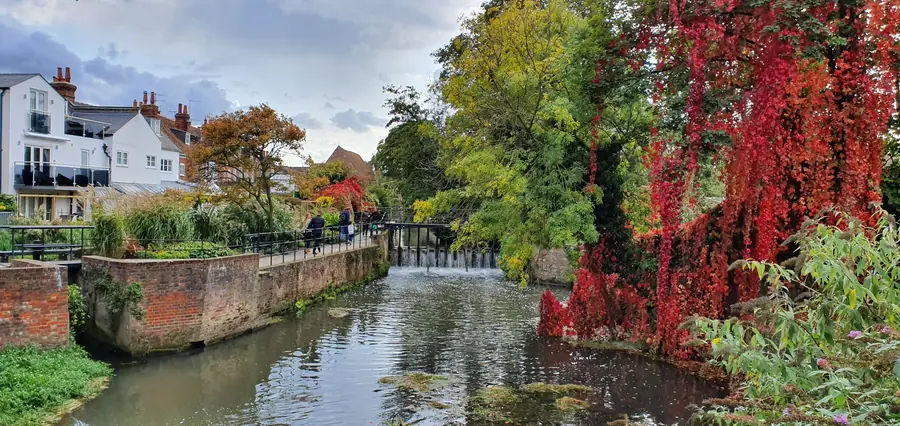
Westgate Gardens run along the Great Stour immediately outside the Westgate, at the western end of Canterbury High Street, and they are the best free thing in the city.
The river splits into several channels here, and the gardens occupy the ground between them: lawns, herbaceous borders, weeping willows over the water, and a stretch of the medieval city wall with a bastion along the eastern side.
It is a five-minute walk from the cathedral and it is where Canterbury goes to sit down.
The centrepiece, and worth walking in for on its own. An oriental plane planted around 1900, with a trunk of extraordinary girth — one of the largest of its species in the country — its lower branches propped and its canopy covering a substantial area of lawn.
Trees of this scale are rare in an English city park, and this one is the thing people photograph after the flowers.
Long and narrow, following the river. The planting is traditional municipal at its best — bedding, borders and roses, changed seasonally — with mown grass, benches and a good deal of shade.
Tower House, the building at the eastern end, is the mayor’s parlour and was gifted with the gardens to the city in the 1930s.
The city wall and a bastion run along one edge, and the medieval Westgate closes the view at the top.
Downstream the path continues along the Stour towards Toddler’s Cove and out of the city; upstream it links to the Great Stour and the walk to Fordwich.
The gardens are council-maintained and, like most municipal parks in the current climate, the standard varies. Regular visitors have commented on the river margins becoming overgrown in recent years, with nettles where there used to be open bank. The lawns and the formal beds are kept well; the wilder edges less so.
That is a fair description of a great many English public parks at present, and it does not stop these being the pleasantest half hour in Canterbury.
Sit. That is the primary use, and the benches under the plane tree are the best of them.
Watch the punts. The Stour punting routes pass along the gardens, and watching someone else pole a boat under a low bridge is free entertainment.
Walk the wall. The surviving stretch here connects into the longer circuit round the eastern side of the city.
Picnic. The lawns take it, and the Goods Shed market by Canterbury West station — five minutes away — is the best place in the city to assemble one.
Free, open at all times.
Level and accessible throughout, with surfaced paths.
Facilities: toilets nearby; cafés and pubs on St Peter’s Street a few paces away.
Dogs welcome.
Best time: early morning for the light on the water, or late afternoon in summer. Spring for the bedding and the blossom.
On foot: through the Westgate arch at the top of St Peter’s Street, five minutes from the cathedral and three from Canterbury West station.
By bus: the city centre stops are a few minutes away.
By car: use park and ride. There is limited parking near the gardens and it is not worth pursuing.
The Westgate Towers, with the museum and rooftop viewpoint, are at the entrance. Punting launches nearby. The Goods Shed market is five minutes north. And the Great Stour path runs downstream through Toddler’s Cove and out towards Fordwich, five kilometres away.
Yes, free and open at all times.
An oriental plane planted around 1900, and one of the largest of its species in Britain.
Not in the gardens themselves. Toddler’s Cove, a short walk downstream along the river, is the city’s main playground.
Yes — the Stour punting routes pass along the gardens.
Five minutes’ walk east along the High Street.