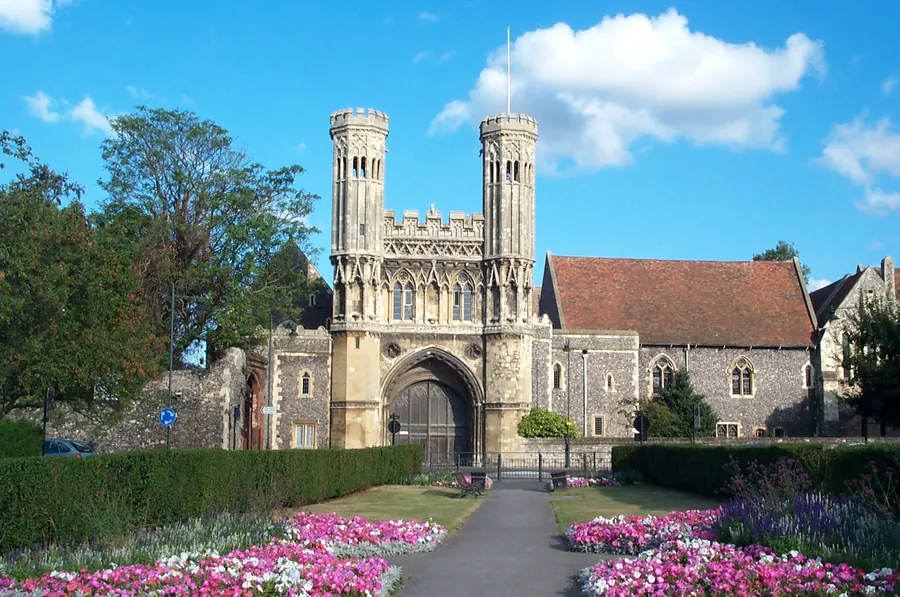
St Augustine’s Abbey stands five minutes east of the cathedral, outside the line of the old city walls, and it is the third component of the Canterbury World Heritage Site alongside the cathedral and St Martin’s Church.
It was founded in 598, a year after Augustine’s mission arrived in Kent, as the burial place of the early archbishops and of the kings of Kent. It functioned as a Benedictine monastery for nine hundred and forty years, until Henry VIII dissolved it in 1538, after which it was systematically dismantled — a process that continued in fits until 1848.
This is where the conversion of the English began, in an organisational sense. Augustine was sent by Pope Gregory the Great, landed in Thanet in 597, and was given a site outside the walls by King Æthelberht of Kent for a monastery — because Roman custom placed burials outside a city.
The abbey became one of the most important religious houses in England and its library one of the great collections of the early medieval West. Its abbots were buried here alongside the kings.
Its destruction was correspondingly thorough. Henry VIII took the site, converted part of it into a royal residence, and let the rest go.
A ruin, but an unusually legible one. The ground plan of the abbey church is laid out, the successive Anglo-Saxon churches beneath it are marked, and the monastic ranges — the cloister, the refectory, the crypt — can be read on the ground.
The Norman abbey church foundations, built over the Saxon churches.
St Pancras Chapel, an early Anglo-Saxon church at the eastern end of the site, built using Roman brick.
The graves of the early archbishops and of Æthelberht and Bertha.
The museum is modern, well done and genuinely useful — it is where the site starts making sense.
Worth taking, and included with the ticket. Visitors consistently single it out, and it is the difference between a field of foundations and a comprehensible building. Families report that it holds children’s attention, which is not a common outcome at a monastic ruin.
English Heritage, with the usual seasonal opening — shorter hours in winter and some days closed. Check before travelling.
Time: an hour to ninety minutes, including the museum and the audio guide.
Access: largely level grass and gravel, with some uneven ground.
Facilities: a shop and toilets; no café on site, but the city is five minutes away.
Combined tickets with other Canterbury sites are sometimes available; ask on arrival.
Doing all three in a day is the best way to understand Canterbury.
The cathedral — the mother church, five minutes west.
St Augustine’s Abbey — the monastery, here.
St Martin’s Church — ten minutes further east, the oldest church in the English-speaking world still in use, where Queen Bertha, Æthelberht’s Christian wife, worshipped before Augustine even arrived. It is small, plain, free, and the oldest of the three.
Together they cover the entire arrival of Christianity in England within about two square kilometres.
On foot: five minutes east of the cathedral along Longport.
By train: Canterbury East is about ten minutes’ walk; Canterbury West about fifteen.
By car: use park and ride — the New Dover Road site is the nearest.
In 598, the year after Augustine’s mission arrived in Kent, on land given by King Æthelberht outside the city walls.
Henry VIII dissolved it in 1538. The buildings were dismantled over the following centuries, with demolition continuing until 1848.
Yes. It is included and it is what turns a set of foundations into a comprehensible building.
An hour to ninety minutes with the museum and the audio guide.
Canterbury Cathedral and St Martin’s Church, both within fifteen minutes’ walk.