Wickhambreaux (pronounced WIK-əm-brew) is a village and civil parish of around 500 people east of Canterbury, on the Little Stour. The reason to go is its plan: the medieval arrangement of church, manor house, rectory, inn and mill encircling the green has survived, with the grander houses on the green and the workers’ cottages in a separate street behind.
It is 7.3 km from Canterbury in a straight line, and Wikipedia puts it just off the A257 Sandwich Road, four miles east of the city. The parish runs north to the River Great Stour and takes in Stodmarsh, so the national nature reserve there is parish ground rather than a separate trip.
Expect a short visit. The village shops closed over the years, and there is no museum and nothing ticketed: a green, a mill, a Grade I church, a pub and a lane of listed buildings.
Coming in from Littlebourne you meet Wickham Mill first: a four-storey white weatherboarded former corn mill, Grade II listed, which keeps its overshot waterwheel. Opposite is the Old Stone House, the former post office, Grade II*. Beyond it the road crosses the Little Stour on a small bridge with white painted railings, and the green opens out.
The church, several large houses and the Rose Inn front the green. Wickhambreaux Court sits on a slope above it, its Regency buff brick façade with green shutters masking an older building that may be medieval in origin. The Old Rectory, Grade II* and Baroque in its leanings, was built in 1714 by the Reverend Alexander Young, and the river runs past the green between banks of willow crossed by footbridges.
South of the rectory is the Rose Inn, Grade II, its rendered two-storey frontage late 17th or early 18th century in appearance. Travellers once used it as a stopping point on the way to Grove, where the Stour could be crossed; it is now one of the few businesses left in the village, at 4.9 from 86 Google reviews. Beside it the 15th-century timber-framed Old Bell House turns the corner into The Street, a narrow lane of closely packed houses built up to the road edge, with 17 listed buildings and 23 locally listed properties. It kept its medieval central drainage gutter until 1966, and is still known locally as Gutter Street.
Wickhambreaux Court was used as the Glueman’s house in Powell and Pressburger’s A Canterbury Tale of 1944, which also filmed the mill and the boys’ battle on the river.
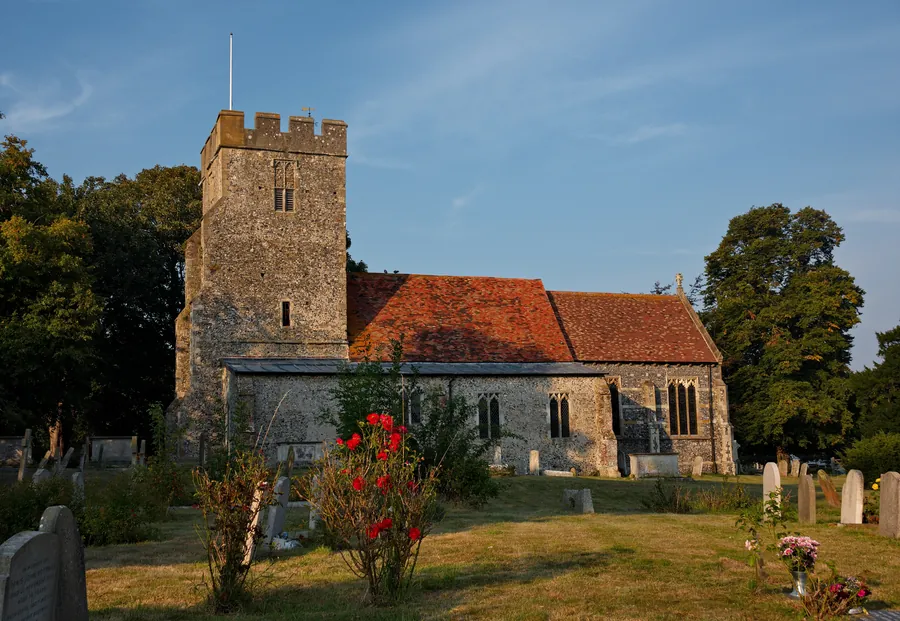
St Andrew’s stands on a small rise north-west of the mill, flint and stone, Grade I listed. It was built in the 13th century, added to in the early 16th and restored in 1868, with a three-bay nave under a tie-beam roof. Wickhambreaux was one of the early Kentish minsters, founded before 700.
The east window is the reason to go in. It is an Art Nouveau Annunciation of 1896, designed by Arild Rosenkrantz and made in John La Farge’s New York studio — the first commission in Europe given to American glassworkers. The donor was “Count” James Francis Gallatin, who dedicated it to his mother, Mrs Harriette Duer de Gallatin. The church is also known locally for its wall painting.
Gallatin was a great-grandson of Albert Gallatin, the longest-serving United States Secretary of the Treasury; his own claim to a title was disputed. Squadron Leader David Maltby DSO DFC, of 617 Squadron, is buried in the churchyard.
The village stands where one of the first Roman roads in Britain crossed the Little Stour, on the way from the landing place at Richborough to Canterbury. It is first recorded in 948, when King Eadred granted land here to a religious woman.
Domesday Book of 1086 calls it Wicheham and lists a church and priest, a park, two mills, two salt pans and three fisheries. The salt pans explain the name — Anglo-Saxon wich, a coastal trading settlement, and ham, a homestead — because the village then stood near the mouth of the Little Stour where it met the Wantsum Channel, then navigable.
In 1352 the manor fell to Joan, 4th Countess of Kent, the Fair Maid of Kent, wife of Edward the Black Prince — buried in Canterbury Cathedral — and mother of Richard II; she held it until her death in 1385.
The primary school still occupies its building of 1869. A second pub, The Hooden Horse in The Street, closed in 1979; its name recalls hoodening, the Kentish custom in which labourers went door to door collecting money, sometimes aggressively, for their Christmas festivities.
Stodmarsh National Nature Reserve, in the north of the parish, is the main outdoor draw, at 4.6 from 447 Google reviews. A visitor in July 2026 wrote, “Hides were all well kept and easy access. However some of the paths are a bit rough and people with mobility issues could struggle,” and added that “Parking is donation based, but it keeps the reserve going so its good to give something.” A visitor in June 2026 reported that “Allegedly there are beavers around the area but we did not see any.”
Howletts Wild Animal Park, on Bekesbourne Lane near Littlebourne, is the other substantial thing within reach, at 4.5 from 5,330 reviews. In July 2026 a visitor recommended “taking a picnic the food and drinks were very pricey”; another that month, giving four stars, noted “a fair few empty cages towards the rear of the site, but this is obviously a good sign that lots of the animals are successfully being released back into the wild.”
Otherwise the pack’s listings are map pins rather than attractions: Wickhambreaux Weir has three Google reviews, the pill box four, the playing fields six.
By road the village lies just off the A257 Sandwich Road, four miles east of Canterbury as Wikipedia gives it, and 7.3 km straight-line from the city centre. The lanes in are narrow, and The Street especially so.
There is no public transport link in the pack. The verified travel material for Canterbury covers the two mainline stations, the park and ride sites and the city’s cycle routes; none of it establishes a bus or train serving Wickhambreaux, and the old station at Grove Ferry and Upstreet, on the far bank of the Great Stour just outside the parish, closed in 1966. Treat this as a car, taxi or bicycle trip unless you can confirm a bus locally.
The village and what is around it, at walking scale.
Open any of them in Google Maps for directions and current opening.
Attractions, prices and availability in Canterbury
These come from GetYourGuide's booking widget, which sets their cookies in your browser. Consent to load it and see the attractions and prices.
Background on Wickhambreaux draws on its Wikipedia article, text there being available under CC BY-SA 4.0.