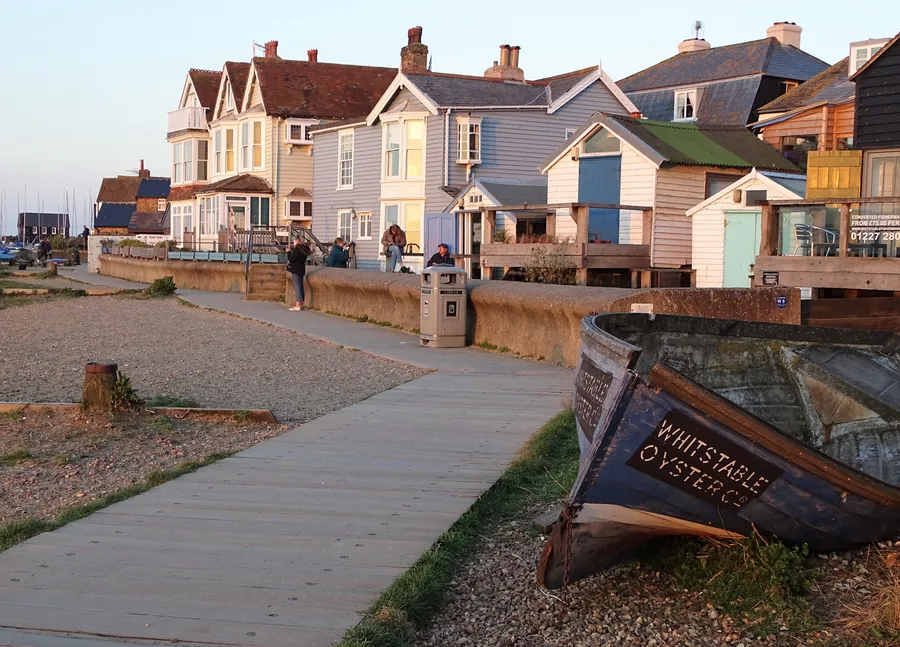
Whitstable is a town of 32,196 people at the 2021 census, on the north Kent coast where the Swale meets the Greater Thames Estuary. It is the sea trip out of Canterbury: a working harbour with a market of black wooden huts selling oysters beside the fishing boats, and The Street, a shingle spit walkable only at low tide.
Wikipedia puts the town five miles (eight kilometres) north of Canterbury; the straight-line distance from Canterbury is 9.8 km. The two have been tied together since 3 May 1830, when the Canterbury and Whitstable Railway opened the world’s first entirely steam-hauled passenger and freight service, six miles (10 km) from Westgate in Canterbury to the town centre here. The line closed in 1953; about a third of it reopened in 1999 as a footpath and cycleway, the Crab and Winkle Way.
The harbour was opened by the railway company in 1832, designed by Stephenson, so that coal could go straight from ships onto trains. It still works: fishing, fish processing, cargo handling, boat storage, and boat trips out to the Kentish Flats wind turbines and the disused wartime sea forts offshore.
The Harbour Market, 4.5 from 2,048 Google reviews, is a run of huts selling seafood, crafts and art. Oysters are what most people stop for: a visitor in July 2026 wrote, “The fresh oysters and other seafoods were amazing.” It is small, and reviewers say so: a visitor in April 2026 called it “Very small but has all the usual shops and touristy stuff”, and another that month noted “There is little parking onsite, but better just across the road.”
Whitstable Castle stands on the boundary with Tankerton. It began as an octagonal tower built in 1789 by Charles Pearson, who owned a copperas works in the town and later invested in the railway, and grew into a manor house; the Whig MP Wynn Ellis bought it in 1836 and had added a west wing, a bell tower and a lodge by 1842. The Whitstable Castle Trust manages it now.
It carries 4.4 from 2,696 Google reviews, and those reviews divide. Entry to the gardens and the castle is free. A visitor in July 2026 wrote, “Free to enter the beautiful gardens and also to visit the castle. However, dogs only allowed outside in the garden.” A visitor in August 2026 was unimpressed: “The castle is far from noteworthy, as for the rose garden, good thing it’s free, it’s really small and unimpressive.”
Both are accurate: it is small, and not a fortress. The interior is not reliably open either, since access is by guided tour — a visitor in May 2025 wrote, “Sadly when we visited there was a wedding so we couldn’t look around the castle inside.”
The Street is a natural strip of shingle on a clay bank running out from the coast at right angles, east of the harbour, for about half a mile (800 m). A survey in 2019 found it to be an especially heavy London clay, all that remains of the saltmarsh that once ran the length of the Swale. It is revealed only at low tide, when it can be walked out along, with sandy-bottomed shallows either side.
It is also the one real hazard here. Wikipedia records that visitors who ignore the warning signs are sometimes trapped by the advancing tide and have to be rescued by the local RNLI lifeboat. Check the tide before setting off, and watch it turn while you are out there. The Street carries 4.7 from 40 Google reviews, too small a sample to weigh heavily.
The view of it is from Tankerton Slopes, the grass bank above the beach huts east of the town, 4.7 from 1,101 Google reviews and home to the largest population in England of the rare hog’s fennel. A visitor in September 2025 reported “Plenty of free parking along the road (can be hard to find a space in peak season and on sunny days).” The beach below, 4.6 from 1,359 Google reviews, is shingle and steep in places; a visitor in July 2018 wrote that “the water is very shallow you have to walk for 1/4 mile to get to deep water to be able to swim”, and one in August 2024 suggested checking “when there is sewage releases in the sea”. The seafront path from there into the town is flat.
Domesday recorded the place in 1086 as Witenestaple, “the meeting place of the white post”. Oysters were harvested here in Roman times and shipped live to Rome, and from 1793 the trade was regulated by the Company of Free Fishers and Dredgers of Whitstable, unusual in owning the freehold of the seabed. At their 1850s peak the local companies sent as many as 80 million oysters a year to Billingsgate. Pollution, disease and overfishing killed the native beds by the middle of the 20th century; Pacific oysters are farmed on the foreshore now, and the nine-day Oyster Festival in July opens with the “Landing of the Catch” and a procession through the streets on a horse-drawn dray.
The line also left the Invicta, the locomotive Robert Stephenson built for it, which was returned to the Whitstable Museum and Gallery on 16 June 2019. The museum, listed as Whitstable Community Museum and Gallery at 4.7 from 186 Google reviews, covers the town’s seafaring, oysters, diving and shipping.
The Crab and Winkle Way is the route that belongs to this pair of places: about seven miles of almost traffic-free riding along the old railway line, walkable as well as rideable. Bike hire is at the Whitstable end rather than in Canterbury — Bay Bike Hire, 9.1 km from the Canterbury centre, and Kent Cycle Hire at 9.9 km, whose own site currently reads “WE ARE TEMPORARILY CLOSED - REOPENING SOON”.
By bus, Stagecoach South East runs a service branded the Triangle about every fifteen minutes between Whitstable, Herne Bay and Canterbury, and Route 5 runs from the town to Canterbury. Canterbury’s buses go from the bus station at the end of the high street, and thin out in the evenings.
By train, Whitstable station is on the Chatham Main Line between Ramsgate and London Victoria, all services operated by Southeastern; Trainline’s fares table gives the fastest Whitstable to Canterbury journey as 25 minutes. By road, the A299 Thanet Way runs past the town and meets the M2 at Faversham.
The village and what is around it, at walking scale.
Open any of them in Google Maps for directions and current opening.
Attractions, prices and availability in Canterbury
These come from GetYourGuide's booking widget, which sets their cookies in your browser. Consent to load it and see the attractions and prices.
Background on Whitstable draws on its Wikipedia article, text there being available under CC BY-SA 4.0.