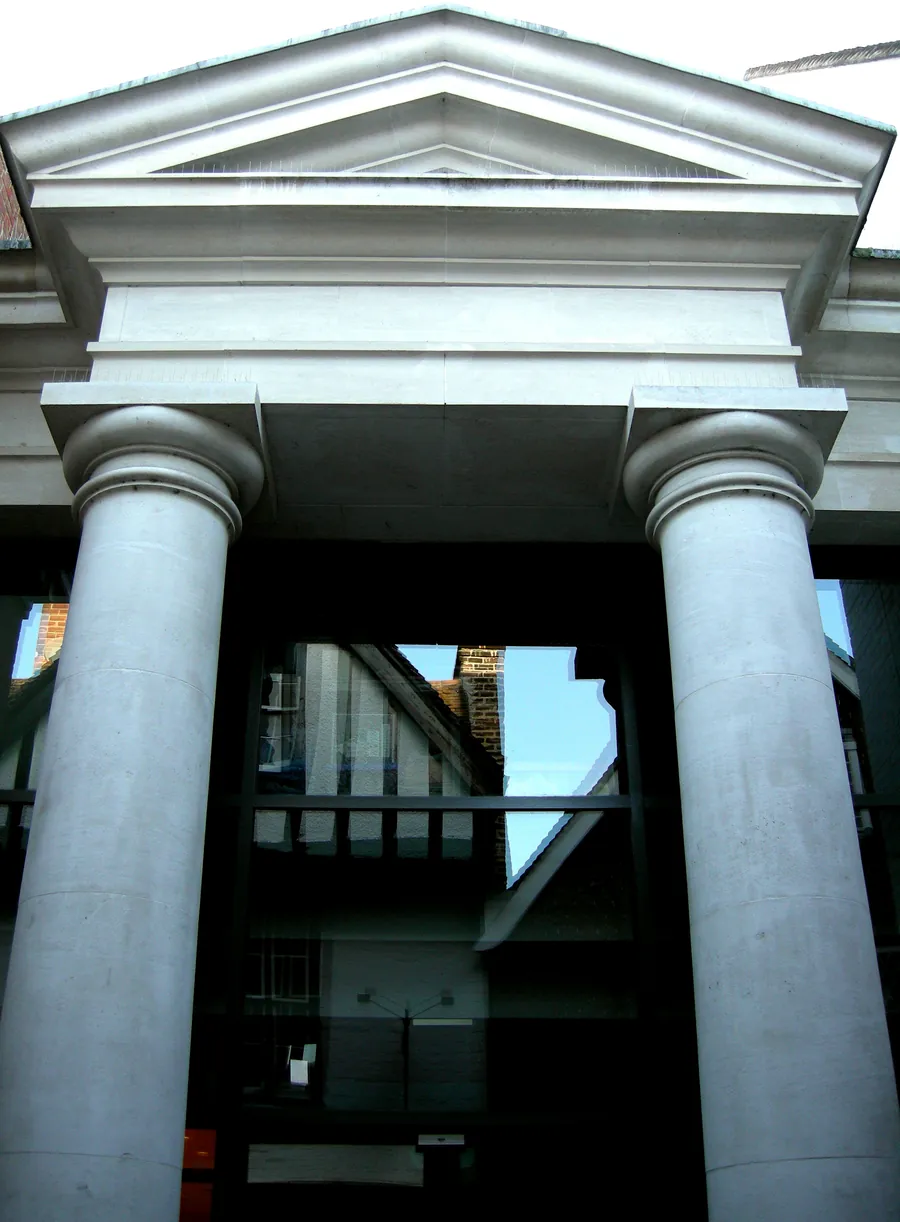
The Canterbury Roman Museum is built underground beneath Butchery Lane, in the middle of the city, and it exists because of the Blitz. German bombing in 1942 destroyed the buildings above, and clearing the rubble uncovered the remains of a Roman courtyard house with its mosaic pavement still in place.
Rather than lift the mosaic and display it elsewhere, the decision was taken to build the museum around it, below modern street level. You descend to the height of the Roman surface and walk past the house where it was built.
Canterbury was Durovernum Cantiacorum, the Roman town of the Cantiaci, established shortly after the conquest of AD 43 on the crossing of the Great Stour and at the junction of the roads from the Kentish ports to London.
It had a forum, public baths, a theatre — a large one, unusually — and a street grid, and it was walled in the third century. The line of those walls is still the line of Canterbury’s walls today, and the street pattern of the modern city centre still partly follows the Roman one.
The museum is where all of that becomes concrete rather than a claim on a plaque.
The mosaic pavement, in situ, a Scheduled Monument, in the remains of a Grade I listed Roman courtyard house — the reason the museum exists.
The hypocaust — the underfloor heating system of the same house, with the pillars that supported the floor.
Finds from the town: pottery, glass, jewellery, coins, tools, and material from the excavations that have run in Canterbury more or less continuously since the war.
Reconstructions — a Roman market place, a kitchen, and touchable replica objects, which work well with children.
Displays on the Roman military and on daily life.
It is a small museum, and a proportion of visitors find the admission price steep for the size. That is a fair observation.
What you are paying for is the in-situ mosaic and the experience of standing on the Roman ground level under a modern shopping street, which no larger museum elsewhere can offer. Allow forty minutes to an hour, go with that expectation, and it is one of the more memorable things in Canterbury.
Older children generally find it more interesting than they expect, largely because of the descent and the touchable material.
Time: forty minutes to an hour.
Location: Butchery Lane, off the High Street, two minutes from the cathedral.
Indoors and underground, which makes it a reliable wet-weather option.
Access: there is a lift down to the museum level; the displays are level.
Combined tickets with the Beaney and other city museums are sometimes available — ask on arrival.
Opening: check seasonal hours before travelling.
The Beaney House of Art and Knowledge on the High Street is free and holds the city’s art and Royal Museum collections — the natural pairing.
The cathedral is two minutes away.
Butchery Lane itself gives one of the best framed views of the cathedral in the city, which is worth a moment on the way in or out.
A Roman pavement from a courtyard house, still in the position it was laid, uncovered when wartime bombing destroyed the buildings above it.
Because it is built at the Roman street level, around remains that were left where they were found rather than moved.
Forty minutes to an hour. It is a small museum.
Yes, for older children — the descent, the reconstructions and the touchable objects do the work.
Yes, there is a lift down to the museum level and the displays are level.